Philippines Rooftop Distributed PV Project Successfully Completed
Recently, the rooftop distributed solar power project in the Philippines, equipped with PV mounting structures from Xiamen Honor Energy Co.,Ltd. has successfully completed all module installation and electrical connection works and is ready for grid connection. Adopting a ballasted racking system on a concrete roof, the modules are mounted elevated above the surface, making full use of the rooftop space without compromising the original waterproofing layer, and delivering clean, stable green power to local commercial and industrial users.
01 Project Overview
The project is located in the Philippines, on the flat concrete roof of an existing building. Taking into account the local climate — high temperature, high humidity and frequent typhoons — the Honor Energy team designed a customized ballasted aluminum racking solution that required no roof drilling at any stage, eliminating the risk of water leakage at its source.
02 Construction Process
From roof layout to the forming of the module array, the project team kept strict control over the quality of every single process. What follows is an on-site record of the entire construction.
2.1 Layout and Support Placement
The work began with axis layout and support positioning on the concrete roof. The ballasted supports sit directly on the structural roof slab, forming a stable connection under their own weight without any chemical anchors or through-fastening — protecting the original waterproofing layer while minimizing impact on the building structure.
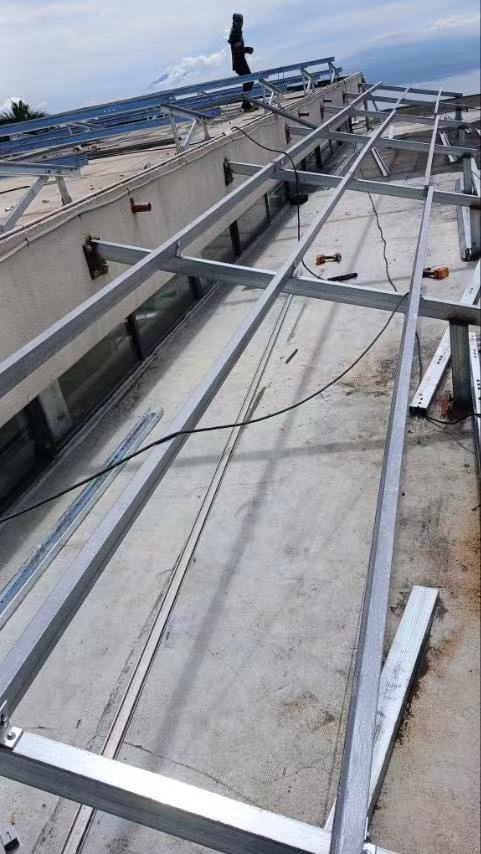
Fig.1 Support placement on the roof
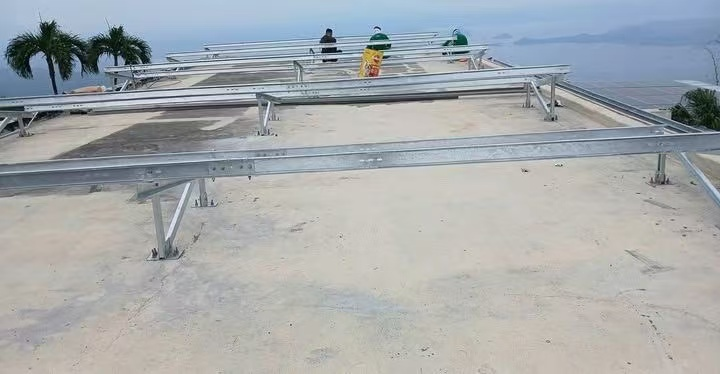
Fig.2 Overall support layout
2.2 Main Beam Assembly
Once the supports were in place, hot-dip galvanized main beams were lapped across them at the designed spacing, forming the load-bearing skeleton of the whole racking system. All bolted joints were anti-corrosion treated to ensure long-term stability in the Philippines' high-salinity, high-humidity environment.
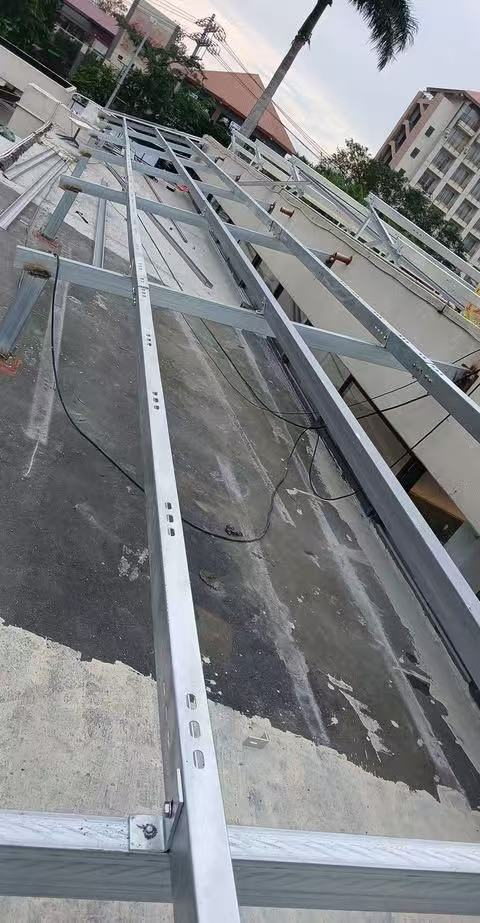
Fig.3 Main beam assembly
2.3 Purlin and Rail Installation
With the main skeleton formed, the process moved on to purlin and rail installation. The rails were laid out parallel to the roof slope at strictly controlled spacing, providing an accurate reference for the module installation to follow.
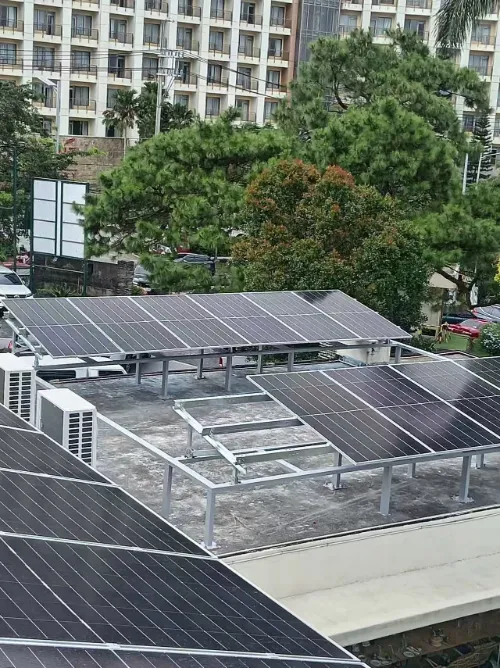
Fig.4 Purlin and rail installation
2.4 Module Installation and Wiring
Modules were pressed onto the rails one by one according to the design layout and locked from the top with dedicated clamps — operable with one hand, greatly improving installation efficiency. As the modules went into place, DC cabling and string wiring proceeded in parallel, with cables routed discreetly along the racking and treated for waterproofing, balancing appearance and safety. Existing rooftop air-conditioning units and parapet walls visible in the photos were all specifically avoided and protected by the team.
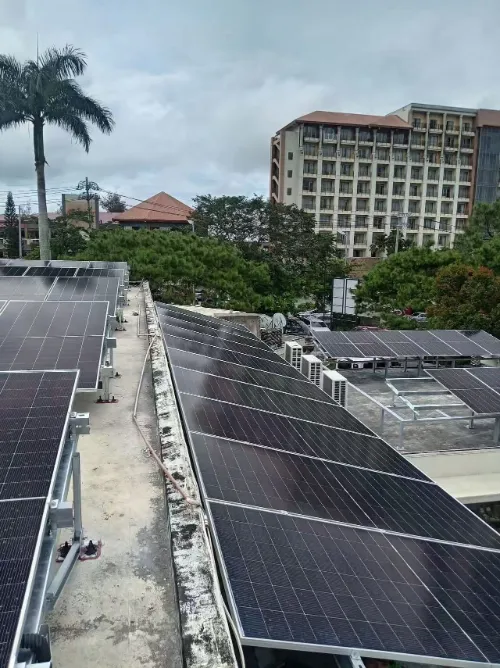
Fig.5 Zonal module laying (I)
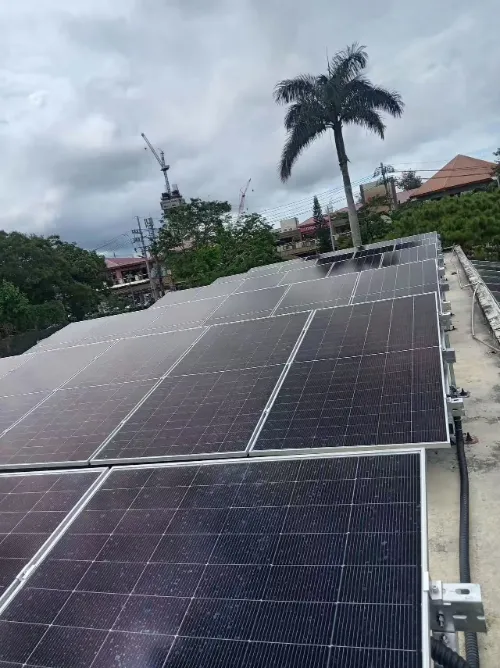
Fig.6 Zonal module laying (II)
2.5 Array Completion and Handover
With the last module locked into place, the entire rooftop PV array took shape. The modules sit in neat, evenly spaced rows, while the elevated structure leaves a ventilation channel beneath them, effectively lowering operating temperature and improving generation efficiency. On inspection, all indicators — racking verticality, module flatness, cable routing and grounding connections — met design and code requirements, and the system is ready for grid connection.
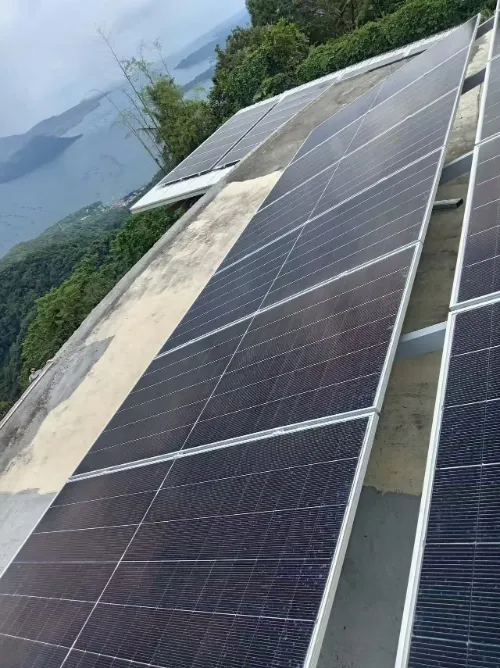
Fig.7 Completed array (I)
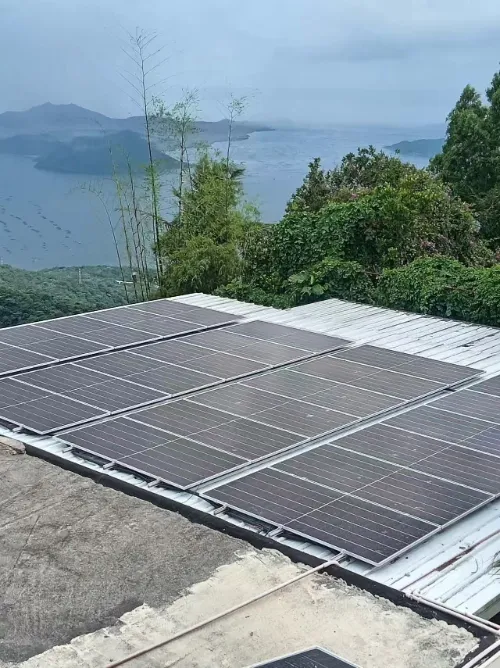
Fig.8 Completed array (II)
2.6 Detailing and Final Touch-ups
During the final phase, the team checked every detail item by item — clamp torque, cable bundling, grounding jumpers — then cleared all construction debris from the roof and restored it to a clean state. The elevated mounting gives the backs of the modules good ventilation, markedly reducing hot-spot risk and leaving ample room for cleaning and maintenance later on.
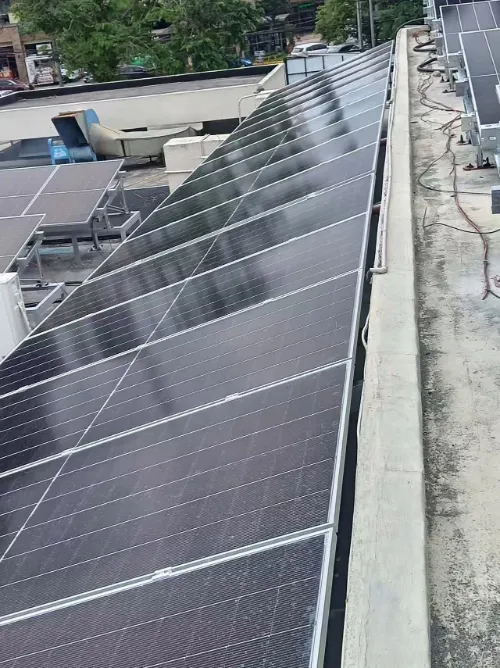
Fig.9 Detailing check (I)
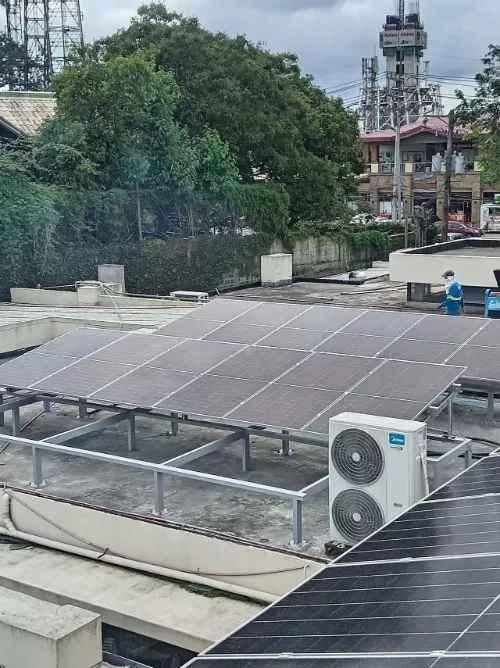
Fig.10 Detailing check (II)
03 Key Technical Features
① Drill-free ballasted mounting — the original waterproofing layer is never compromised, eliminating leakage risk at its source.
② Built for the tropics — hot-dip galvanizing and anti-corrosion treatment across all steel joints resist salt spray and humidity for a long service life.
③ Ventilated design — modules sit elevated with natural airflow underneath, lowering operating temperature and boosting system efficiency.
④ Wind resistance meets drainage — ballast load and a low profile improve wind stability, while the elevated space preserves the roof's original drainage paths.
⑤ Fast installation — top-down clamp fixing keeps the process simple; combined with zonal flow construction, site duration is cut substantially.
Next :
-
Related News
Leave me a message